F Forge Project Guide

Features

Forge helps you plan clearly, act consistently, and reflect honestly.

This page walks through Forge’s main capabilities in plain language so you can understand what the product is for, what kind of information it keeps, and how the web app, API, and companion fit into the same system.

Execution And Planning

Forge turns goals into work you can actually carry through.

Canonical hierarchy

Forge plans work through one explicit ladder: Goal > Strategy > Project > Strategy > Issue > Task > Subtask. Projects are PRD-backed initiatives. Issues are vertical slices across the stack. Tasks are one focused AI session each, and subtasks are lightweight child steps.

Goals, projects, issues, tasks

Forge stores long-horizon goals, PRD-backed projects, vertical-slice issues, executable tasks, and subtasks as linked first-class planning records.

Strategies

Strategies remain flexible and can sit above projects or inside a project plan, which keeps both strategy layers visible in the hierarchy instead of flattening everything into one list.

AFK and HITL issues

Each issue can be marked AFK when AI can complete it autonomously or HITL when a human decision is required at some point in the slice.

Shared issue and task contract

Issues and tasks can both preserve execution mode and acceptance criteria, while tasks keep direct AI execution guidance in aiInstructions.

Live work sessions

Task runs record active or historical timed work, credited duration, manual adjustments, and current focus state.

Mixed Kanban + hierarchy

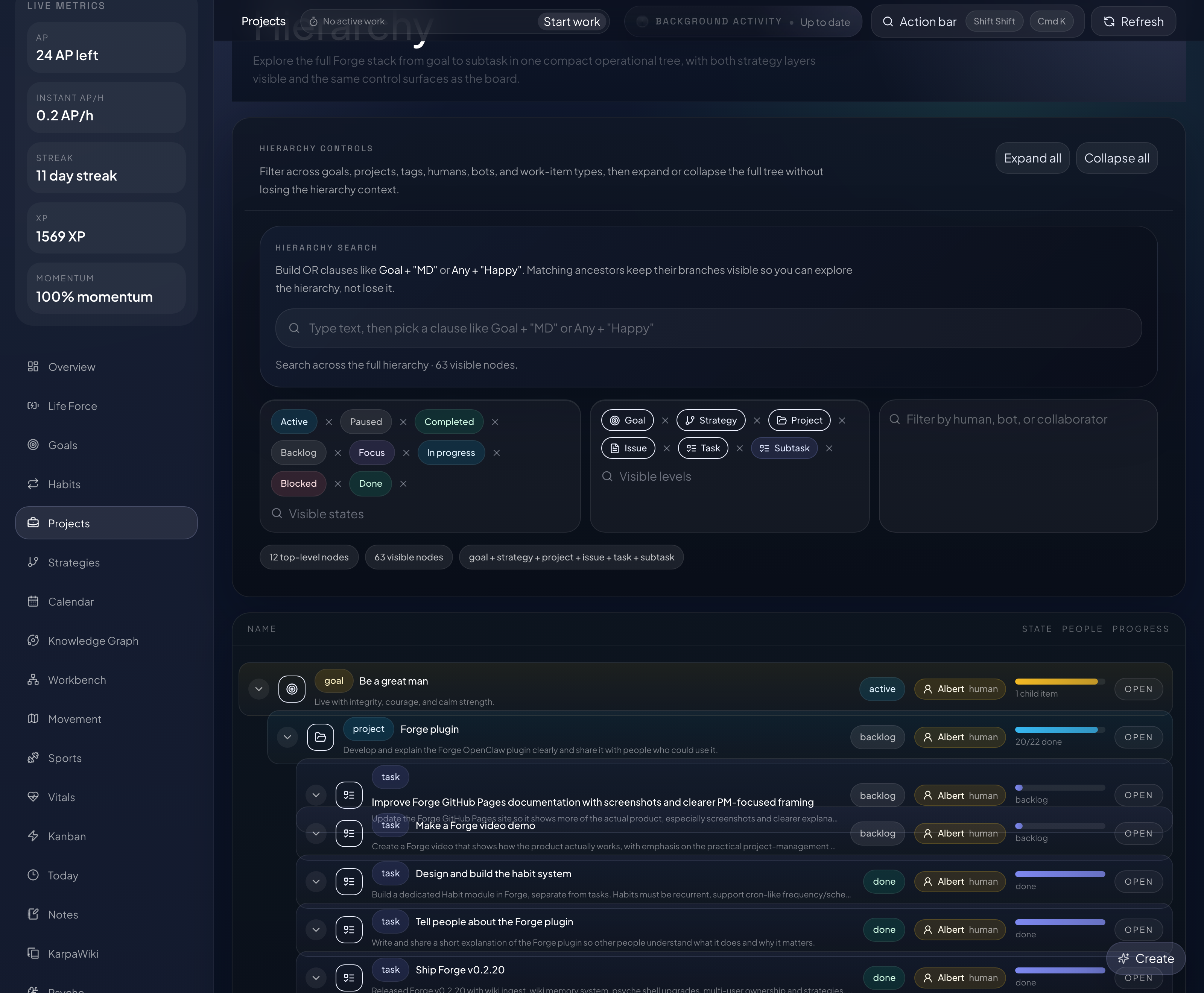
Forge's PM workspace now supports a mixed-level board and a compact hierarchy tab, so you can browse work as lanes or as a full tree without losing context.

Shared filters and linking

The board and hierarchy share search, state filters, level visibility, human and bot attribution filters, and hierarchy linking flows that can select or create the right parent record from one search-first modal.

Task closeout

Completed work can preserve modified files, a concise work summary, and linked git refs, so agents leave behind a truthful delivery record instead of only flipping a status field.

Recurring habits

Habits are not task aliases. They have their own recurrence logic, check-in history, and reward consequences.

Calendar scheduling

Forge supports provider connections, work blocks, native events, and task timeboxes under one runtime model.

Reward ledger

XP and reward events are attached to concrete runtime behavior rather than decorative counters.

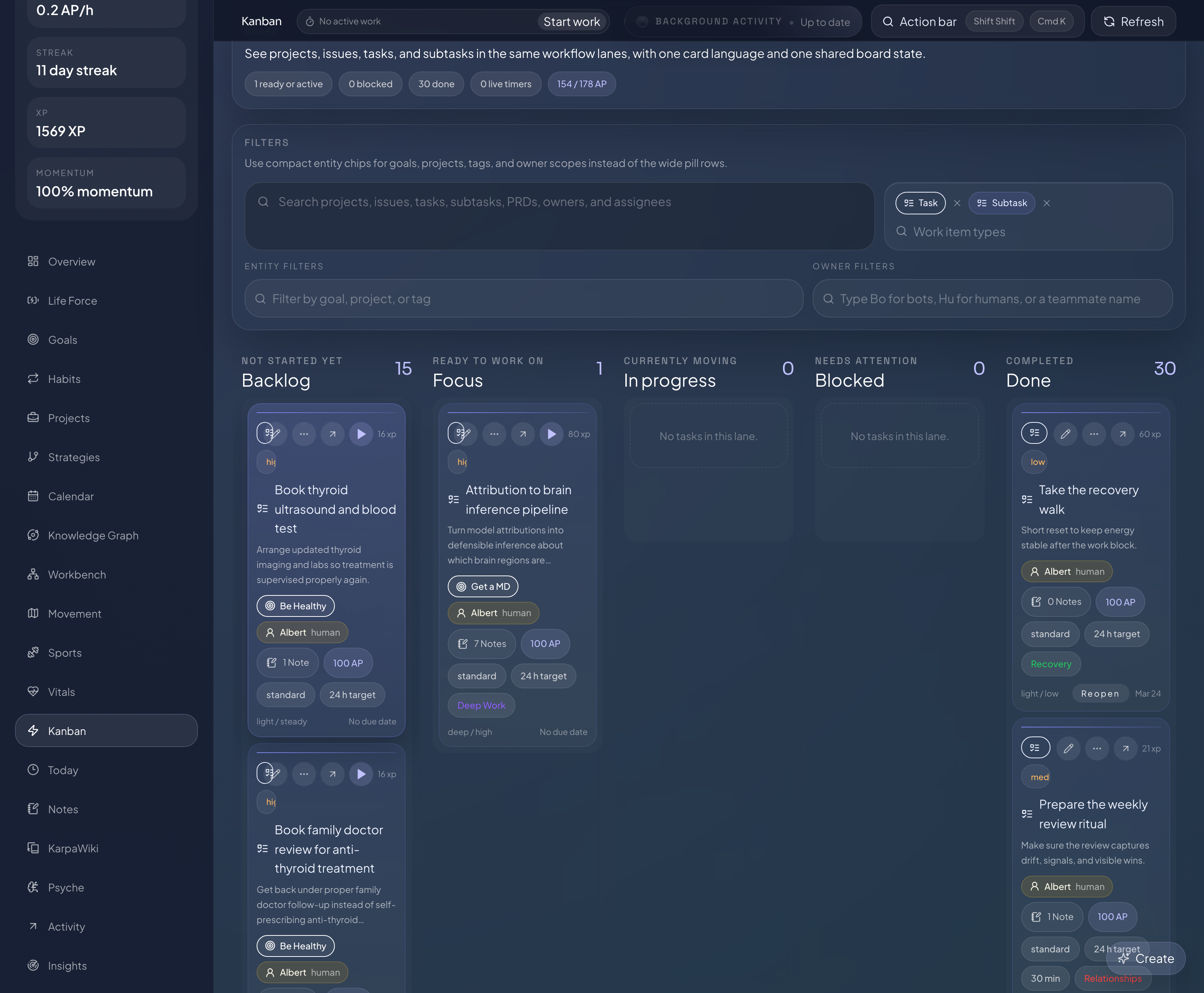
Forge Kanban board showing the mixed board with execution lanes and task controls.
The mixed board stays optimized for movement and flow: lane-based execution, owner scopes, direct task actions, and the fast review loop you need when work is actively moving.
Forge hierarchy view showing the planning tree from goals down to subtasks.
The hierarchy view complements that board with the whole planning tree at once, so you can inspect goals, projects, issues, tasks, and subtasks without losing the parent-child structure.

Memory And Knowledge

Forge keeps context, notes, and preferences close to the work.

Notes

Notes are first-class Markdown evidence records with links to tasks, projects, goals, Psyche records, and other entities.

Wiki

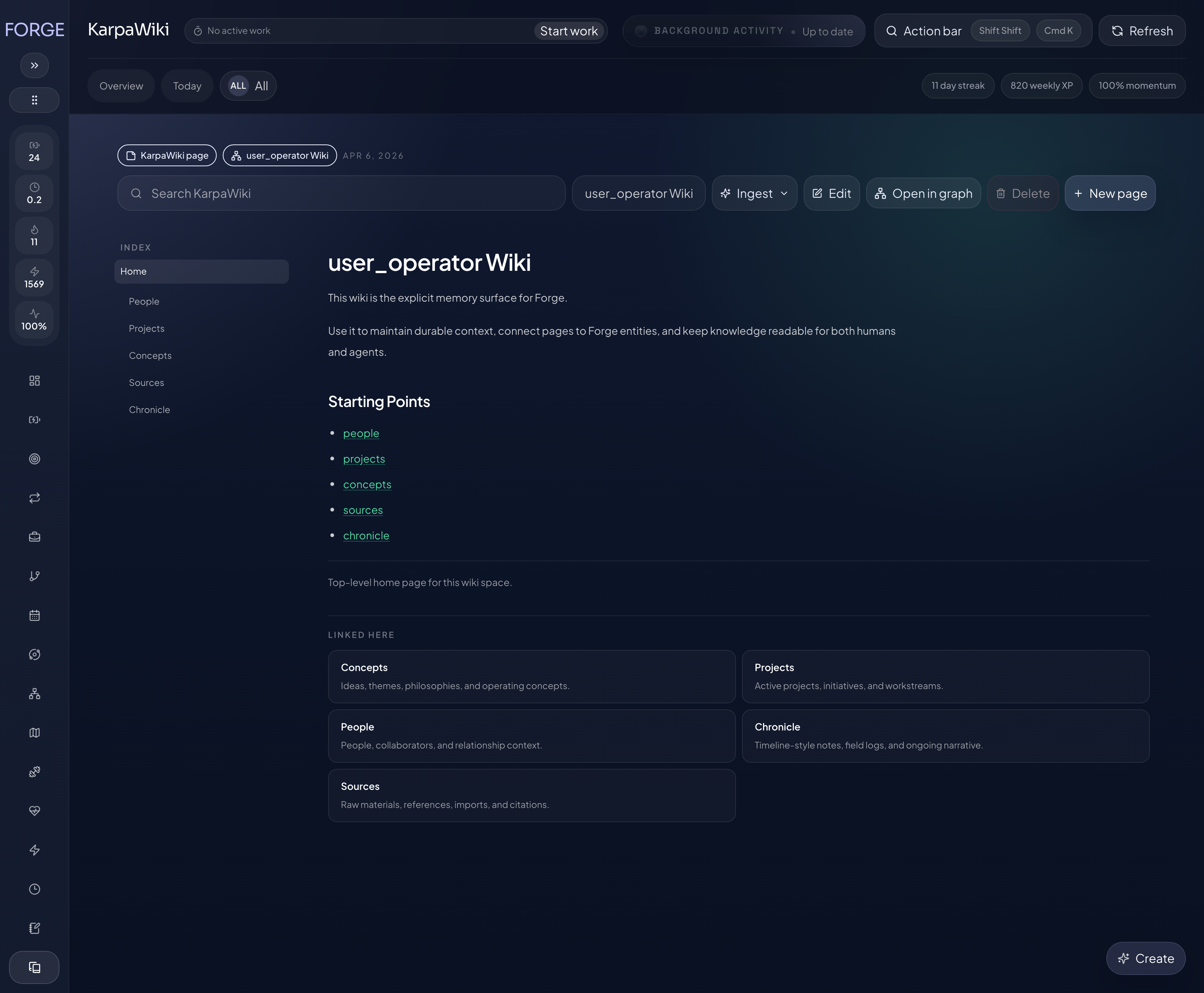
The wiki is file-first and supports pages, backlinks, vault sync, ingest, search, semantic indexing profiles, and explicit settings.

Tags

Shared tags provide classification across notes, goals, projects, issues, tasks, subtasks, and other records, with Forge PM shipping explicit `feature`, `bug`, and `knowledge` tags.

Preferences

Preference profiles, contexts, signals, comparisons, and inferred scores are stored as inspectable data rather than opaque assistant output.

Search and browse

Forge supports runtime browse views, text search, and entity-linked search across the main knowledge surfaces.

Multi-user ownership

Records can belong to human or bot users, and the runtime supports explicit cross-owner reads and linked work.
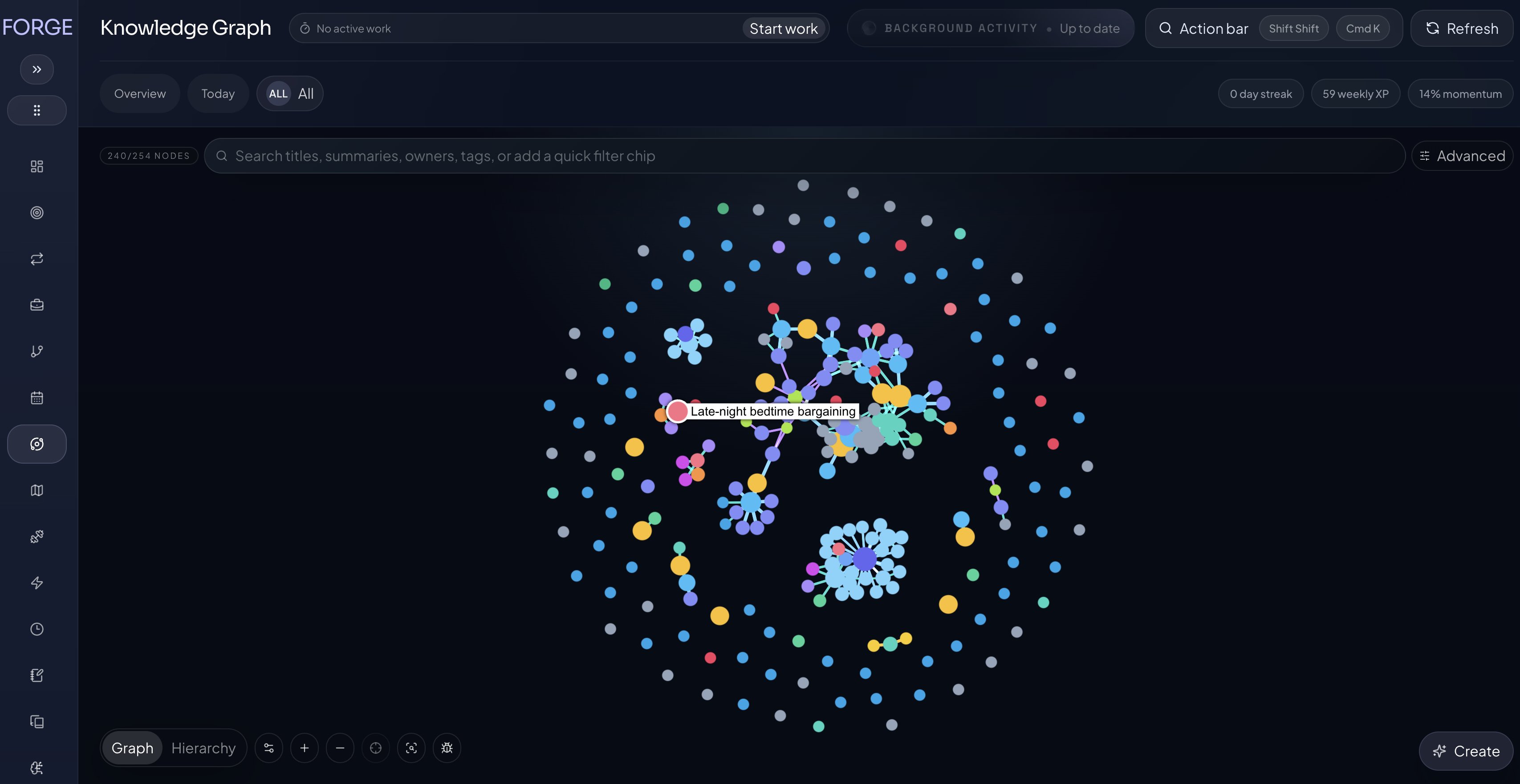
Forge knowledge graph showing linked notes, projects, concepts, and related entities.
The knowledge graph helps you see how projects, ideas, people, patterns, and notes connect, so Forge becomes a navigable map of your system instead of a pile of disconnected records.
Forge wiki page showing the shared memory space, index, and linked pages.
The wiki gives that graph durable written form: readable pages, linked concepts, and long-lived context that both humans and agents can return to over time.

Health And Reflection

Health and self-observation are part of the system, not an afterthought.

Sleep records

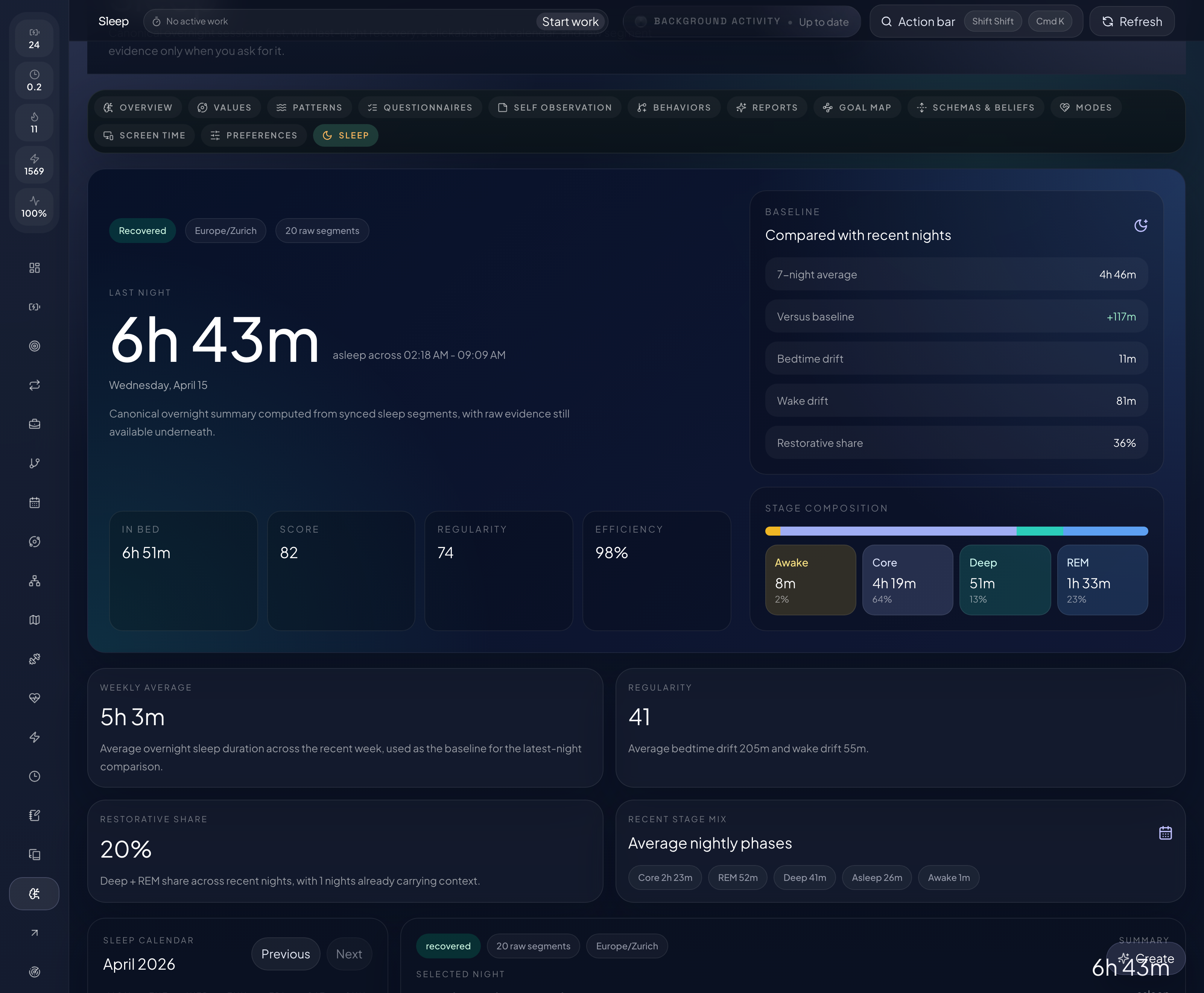
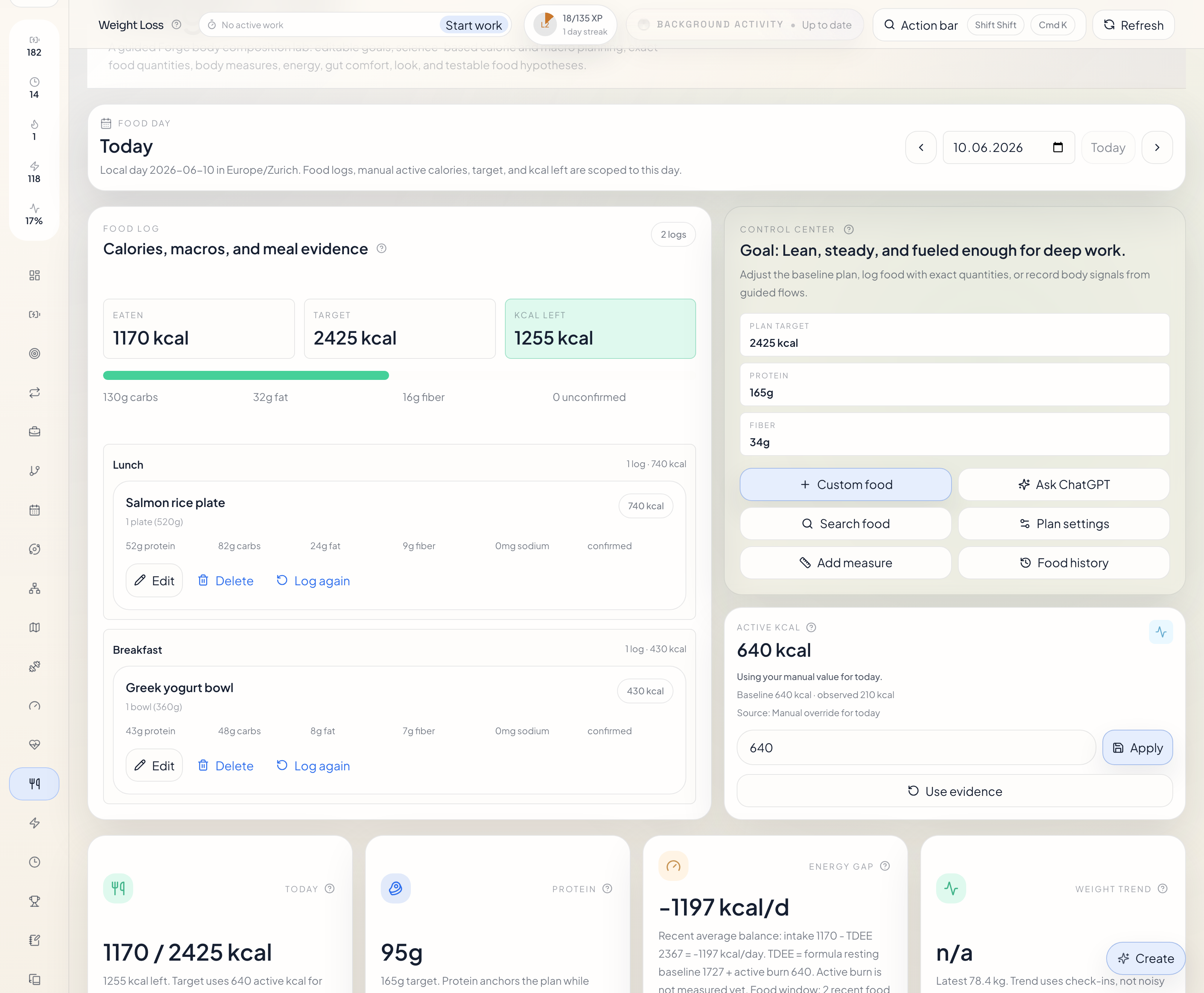
Sleep sessions store start and end time, time asleep, time in bed, stage breakdown when available, derived metrics, and linked context.

Sports and workouts

Workout sessions store type, duration, distance, energy, annotations, provenance, and links back to goals, habits, sleep, and Psyche data.

Psyche model

Values, beliefs, behaviors, patterns, modes, reports, questionnaires, and insights all live as structured runtime records.

Weekly reviews

Review routes and stored summaries support regular close-out and system-level reflection on what changed.

Activity history

Activity feeds and event logs provide an operational timeline across execution, knowledge capture, and reflection surfaces.

Health import

The iPhone companion can import HealthKit sleep and workout data into the same Forge runtime model.

Forge Sleep page showing the latest canonical night summary, sleep calendar, and selected-night phase timeline.
Sleep is centered on the overnight session: the latest night summary, weekly baseline, calendar browsing, and selected-night phase timing are visible by default, while deeper evidence stays one click away.
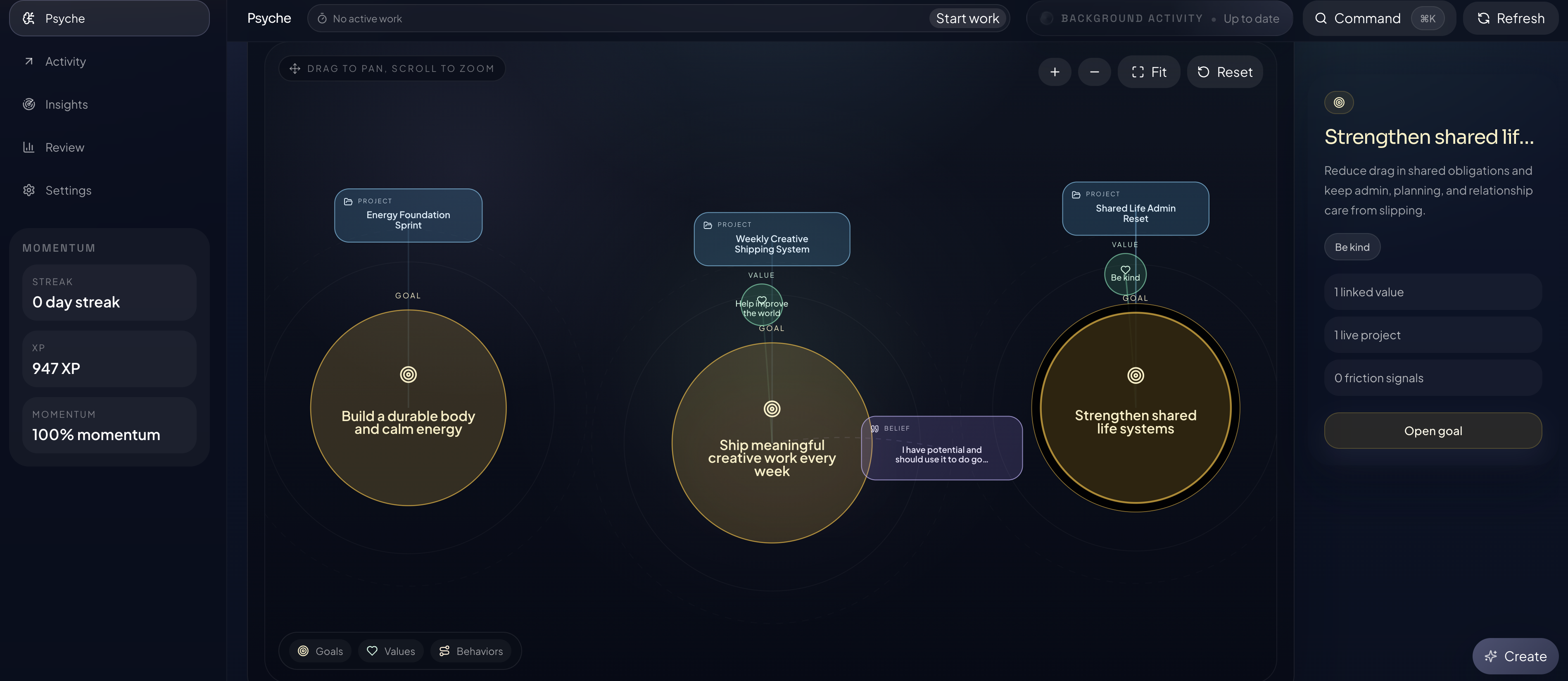
Forge Psyche graph showing linked values, reports, and related reflective entities.
Psyche adds structured reflection around those health signals, so values, beliefs, behaviors, patterns, modes, and reports can stay linked to what was happening in the rest of life.

Agents And Integrations

Forge stays useful whether you are in the browser, an agent host, or on your phone.

OpenClaw and Hermes

Agent adapters expose curated Forge tools for overview, mutation, notes, wiki, habits, strategies, health, and UI handoff rather than dumping the entire internal API surface.

Multi-agent collaboration

Forge gives humans and bots their own visible identities, ownership lanes, and relationship rules so collaboration stays understandable instead of becoming hidden automation.

HTTP API and OpenAPI

The runtime serves a versioned API under /api/v1/ and a generated OpenAPI 3.1 document that powers the public interactive docs.

Contracts and permissions

Collaboration contracts define who can see, message, plan with, or directly mutate someone else's work, which makes shared execution safer and more accountable.

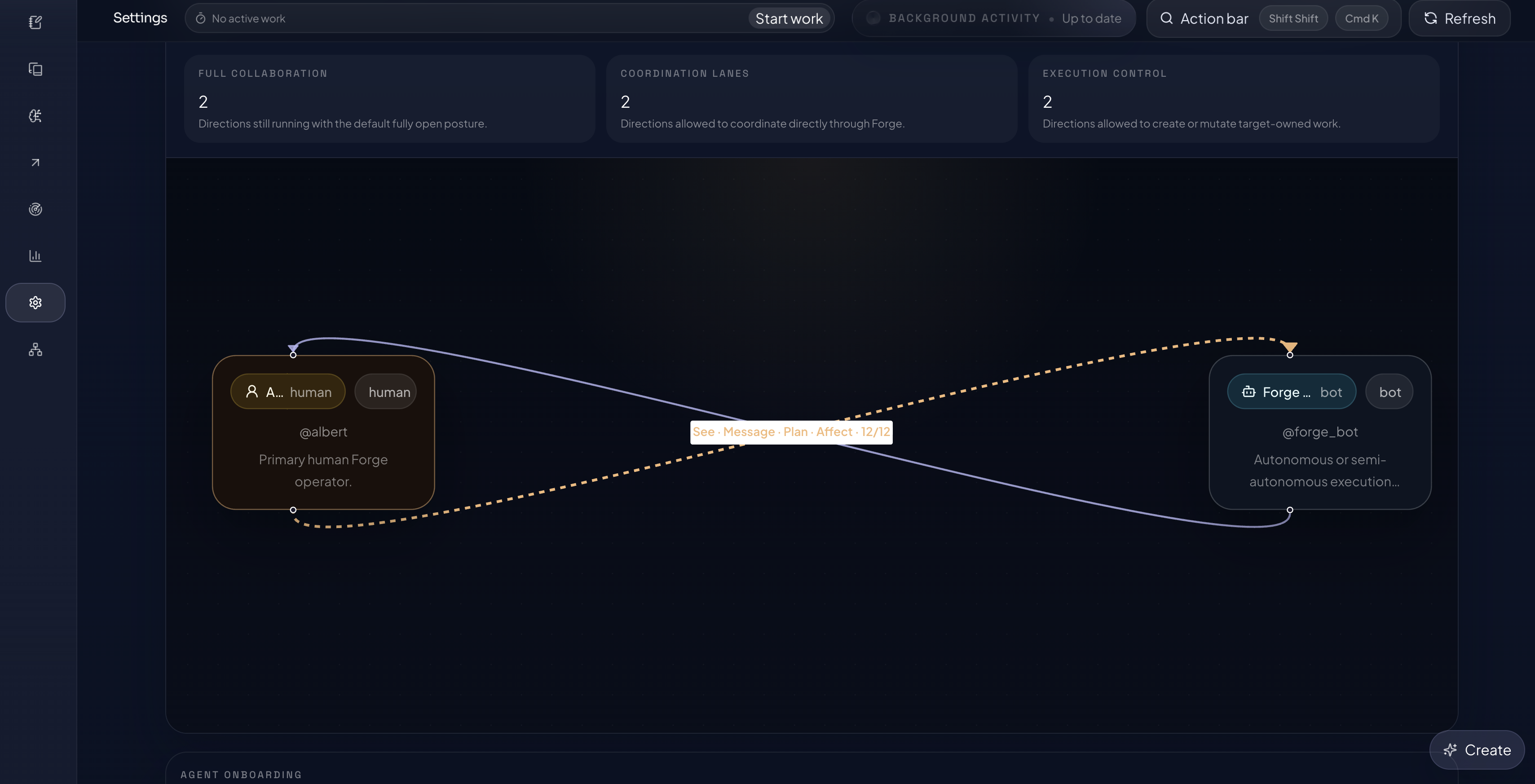
Forge multi-agent collaboration view showing a human and a bot linked by planning, coordination, and execution relationships.
Forge treats multi-agent work as an explicit relationship model. Humans and bots can collaborate inside one system, but the connection stays visible: who owns the work, who may coordinate, and who is allowed to execute changes are all shown directly.

What this means for the user

A human can keep strategic control while letting a bot help with planning, note-taking, or execution. Forge makes that legible by separating three ideas that usually get mixed together.

Visibility answers who can inspect another lane. Coordination answers who can message, link, and plan across lanes. Execution control answers who can create or mutate target-owned records.

The result is a shared operating system where automation feels trustworthy: bots are collaborators with explicit contracts, not invisible background scripts acting without context.

Consistency

The same Forge system powers every surface you use.

Concern Current behavior
Web UI Mounted under /forge/ with responsive desktop and mobile surfaces.
API Mounted under /api/v1/ with a generated OpenAPI document.
Docs Published through GitHub Pages with a product guide and interactive API explorer.
Storage Local-first SQLite plus file-backed wiki content.